Tokyo rents hit record highs as listed rents outpace tenant inquiry levels

Japan’s rental housing market continues to tighten, particularly in the capital, as new data shows rents across Tokyo reaching fresh highs. According to the latest market report from LIFULL, operator of the major Japanese property portal LIFULL HOME'S, both family-type and single-occupant rental listings climbed sharply in February 2026, with central Tokyo leading the increase.
The data highlights a growing imbalance in the Tokyo rental market: landlords are raising listing prices significantly faster than tenants appear willing - or able - to pay. As a result, the gap between advertised rents and inquiry rents continues to widen across multiple housing segments.
Data Coverage
The report analyzes residential rental apartments and condominiums listed on LIFULL HOME'S and compiled on a monthly basis.
The dataset used in this analysis includes monthly market data from January 2020 through February 2026.
Single-occupant units include:
Studio, 1K, 1DK, 1LDK and 2K layouts.
Family-type units include:
2DK, 2LDK, 3K, 3DK and 3LDK or larger layouts.
In the dataset, “Tokyo’s non-23 wards” refers to municipalities within Tokyo Prefecture excluding the central 23 wards.
Family-Type Rentals in Tokyo’s 23 Wards Reach Record Levels
For larger family-oriented units, the average listed rent in Tokyo’s 23 wards reached ¥255,765 in February 2026, representing a 12.3% increase compared with the same month a year earlier.
The figure marks a new record high and extends the upward trend to 19 consecutive months of rent increases.
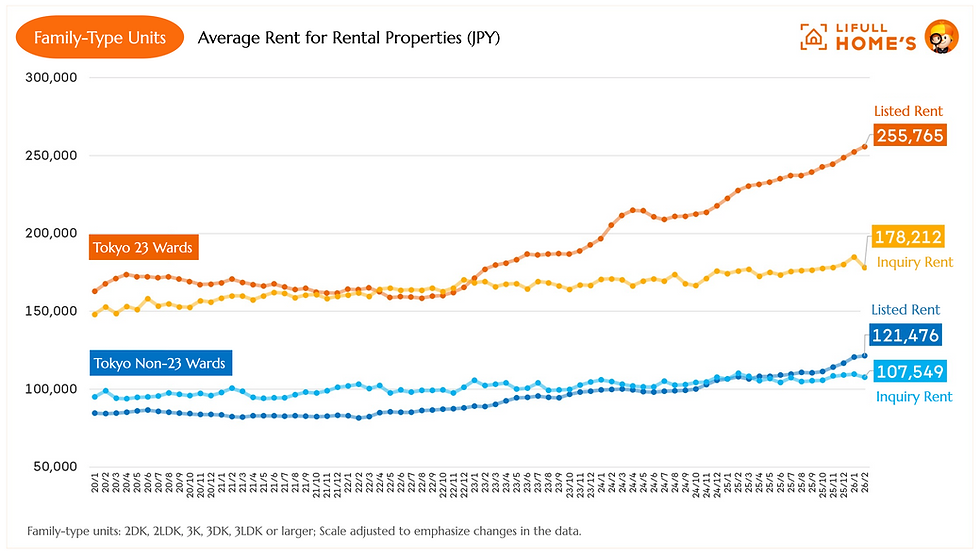
Graph courtesy of LIFULL HOMES, edited by Patience Realty.
However, rents associated with tenant inquiries - often viewed as a closer reflection of actual market demand - remain considerably lower. Inquiry rents averaged ¥178,212, rising only 1.2% year-on-year and leaving a gap of ¥77,553 between listed and inquiry rents.
Rental prices are also rising beyond the capital’s core districts. In Tokyo’s non-23 wards, family-type listing rents reached ¥121,476, up 12.6% year-on-year and another record high.
The difference between central Tokyo and surrounding areas continues to expand. The gap in listed rents between Tokyo’s 23 wards and Tokyo’s non-23 wards widened to ¥134,289, the largest difference recorded to date.
Smaller Units Experience Faster Rent Growth
Rent pressure appears even more pronounced in the single-occupant housing market, where demand for compact apartments remains strong.
Average listed rents for smaller units in Tokyo’s 23 wards rose to ¥132,903, representing a 19.2% year-on-year increase and setting another new record. On a month-to-month basis, rents rose 5.6%, the largest monthly increase observed in the dataset.

Graph courtesy of LIFULL HOMES, edited by Patience Realty.
Inquiry rents for the same category averaged ¥95,508, up 2.9% year-on-year. This expanded the gap between listed and inquiry rents to ¥37,395, reinforcing the broader trend of listing prices rising faster than tenant budgets.
In Tokyo’s non-23 wards, listed rents for single-occupant units reached ¥63,326, up 7.0% year-on-year. Inquiry rents averaged ¥66,557, leaving only a ¥3,231 difference, suggesting that listing prices and tenant expectations remain more closely aligned outside central Tokyo.
Central Tokyo’s Rent Premium Continues to Expand
One of the clearest trends emerging from the data is the widening rent premium commanded by properties located within Tokyo’s 23 wards.
Central districts benefit from proximity to major employment centers, dense transportation networks, and established urban amenities. These advantages continue to attract residents despite rising housing costs, allowing landlords to maintain significant pricing power compared with Tokyo’s non-23 wards.
At the same time, more moderate rent growth outside the central wards suggests suburban markets may be approaching a period of stabilization following the pandemic-era migration patterns that temporarily boosted demand in outer areas.
Listing Rents Are Rising Faster Than Tenant Budgets
Perhaps the most notable signal from the February data is the widening spread between listing rents and inquiry rents.
While advertised rents have climbed sharply, the rents associated with tenant inquiries have increased much more gradually. This divergence indicates landlords may be testing higher price levels in a tightening market, while tenants remain constrained by affordability.
If the gap continues to widen, the Tokyo rental market may eventually see listing prices stabilize as landlords adjust expectations to maintain occupancy.
Further Reading:
LIFULL Homes Greater Tokyo Listed-Rent-to-Inquiry data from Jan. 2020 to Feb. 2026 (Japanese only; in Excel format)
Source:
Kenbiya (Japanese only)