Takanawa condo rebuild turns complicated land rights into freehold ownership

Nippon Steel Kowa Real Estate and the Metropolitan Area Fireproof Building Public Corporation announced on June 2nd that the Takanawa Building Condominium Reconstruction Project in Minato Ward, Tokyo, received approval for its rights conversion plan from Minato Ward earlier in May.
The approval marks an important step in a complex rebuild that will convert the aging Takanawa Building from a condominium based on land-use rights into a freehold condominium, while also incorporating adjacent land into the project site.

CG rendering of finished building exterior courtesy of press release linked at the bottom of this article.
Both entities are participating in the project as association members. The reconstruction resolution was unanimously approved by the unit owners in February 2024, and the Takanawa Building Condominium Reconstruction Association, which will act as the project executor, received approval for its establishment in October of the same year.
The project site is located three minutes on foot from Shirokane-Takanawa Station on the Tokyo Metro Namboku Line and Toei Mita Line.
The existing Takanawa Building was completed in 1967 as a 12-story steel-reinforced concrete mixed-use condominium with residences, offices and retail space. It has a total floor area of 5,089 square meters and 40 units.
The old Takanawa Building had a complicated land-rights structure. Unlike a straightforward freehold condominium, where unit owners hold proportional ownership interests in both their units and the land beneath the building, the property was built on land-use rights over land owned by another party.
In practical terms, the unit owners owned their individual condominium units, but the building stood on land that was not directly owned by them in the usual freehold condominium structure.
That distinction is significant because rebuilding a condominium in Japan usually requires not only agreement among the unit owners, but also a workable legal structure for the land beneath the building.
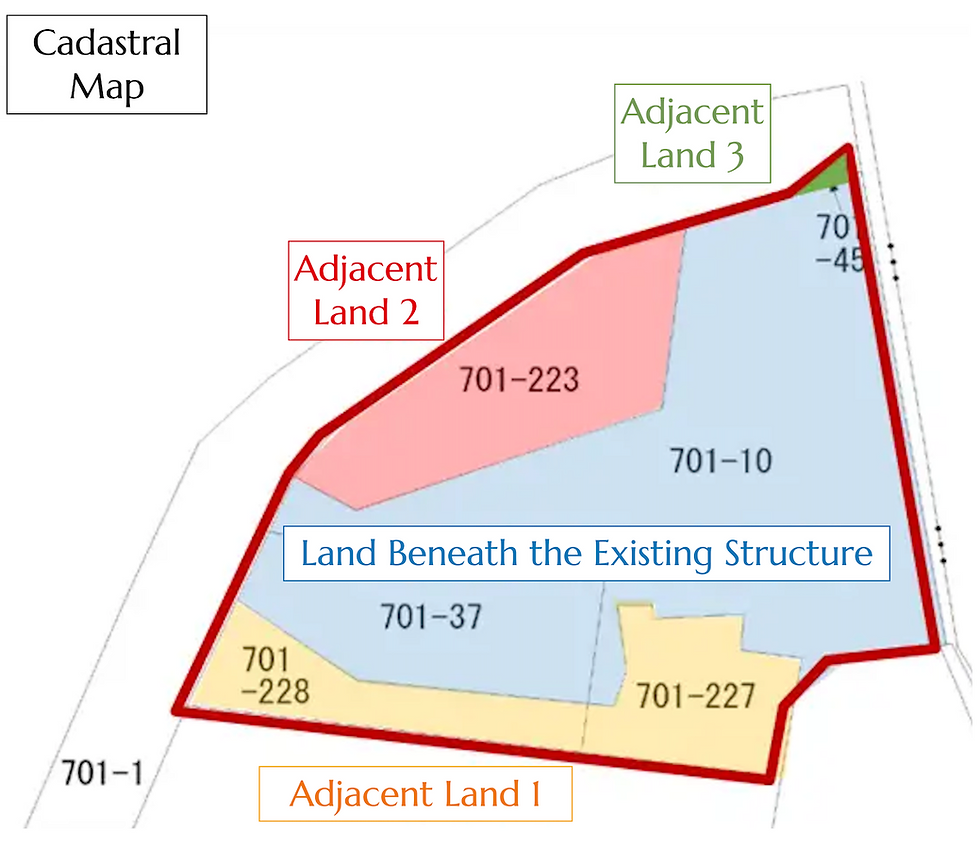
Overhead cadastral map of the previous land footprint highlighting adjacent land. Map courtesy of the press release edited by Patience Realty.
In this case, the original site also appears to have been too constrained to support the larger replacement building on its own. Incorporating the adjacent land was therefore central to making the 18-story plan viable and approvable.
By expanding the land footprint, the project could be presented as a single integrated site capable of supporting the larger building approved under the rights conversion plan.
To resolve these issues, the project uses a rights conversion scheme that reorganises the old surface-rights structure into freehold ownership interests in the rebuilt condominium.
Rather than requiring each individual unit owner to separately purchase rights to the underlying land upfront, the reconstruction association will acquire the land beneath the existing building and convert the old rights structure based on the existing surface-right ratios.
Nippon Steel Kowa Real Estate also acquired the underlying land and adjacent land at an early stage, before the reconstruction policy was finalised. This helped remove a major source of consensus-building risk by securing landowner cooperation before the project advanced further.

Current versus rebuilt profile graphic courtesy of press release, edited by Patience Realty.
As a result, the land footprint will expand from 1,250 square meters to 1,772 square meters. The rebuilt condominium is planned as an 18-story reinforced concrete building with 103 units and a total floor area of 12,500 square meters.
The Takanawa project also reflects a broader rebuild model being promoted by Nippon Steel Kowa Real Estate. The company has positioned condominium regeneration as a core business area, with experience in difficult projects involving leasehold rights, mixed-use buildings and adjacent-site consolidation.
In past projects, it has also worked on schemes that convert aging leasehold condominiums into freehold condominiums.
For owners of aging condominiums in Japan, the project shows how challenging rebuilds may become possible when land rights, adjacent sites and owner consensus are handled together rather than separately.
This is especially relevant for older urban buildings where seismic concerns, complex ownership structures and small or irregular sites can make a simple one-site rebuild difficult.
Completion is scheduled for February 2032.
Sources:
R.E. Port News (Japanese only)
PR Times Press Release (Japanese only)